
Understanding the Hungarian electoral system
This short guide is a neutral description of the Hungarian election system and, specifically, how votes are converted into parliamentary seats. The educational video below (in Hungarian with English subtitles) aims to facilitate your understanding of the system.
How many votes do voters cast in the general elections?
Those with a registered Hungarian address can cast two votes: one on any of the national party lists and another on their preferred candidate in the single-member constituency their address belongs to.
Those without a registered Hungarian address can vote for the national party lists only.
Who can vote in person and by mail?
Those with a registered Hungarian address can only vote in person (at a polling place in Hungary or, if they are abroad, at one of Hungary’s official representations).
Those without a registered Hungarian address can vote by mail.
Whose names may appear on the ballot?
An individual becomes an official candidate in a single-member constituency if they gather 500 valid recommendation signatures. A citizen can recommend multiple candidates, but only within their own single-member constituency.
A political party can field a national party list if they field a candidate in 71 out of the 106 single-member constituencies, with at least one candidate in Budapest and candidates in at least 14 counties.
How are votes turned into parliamentary seats?
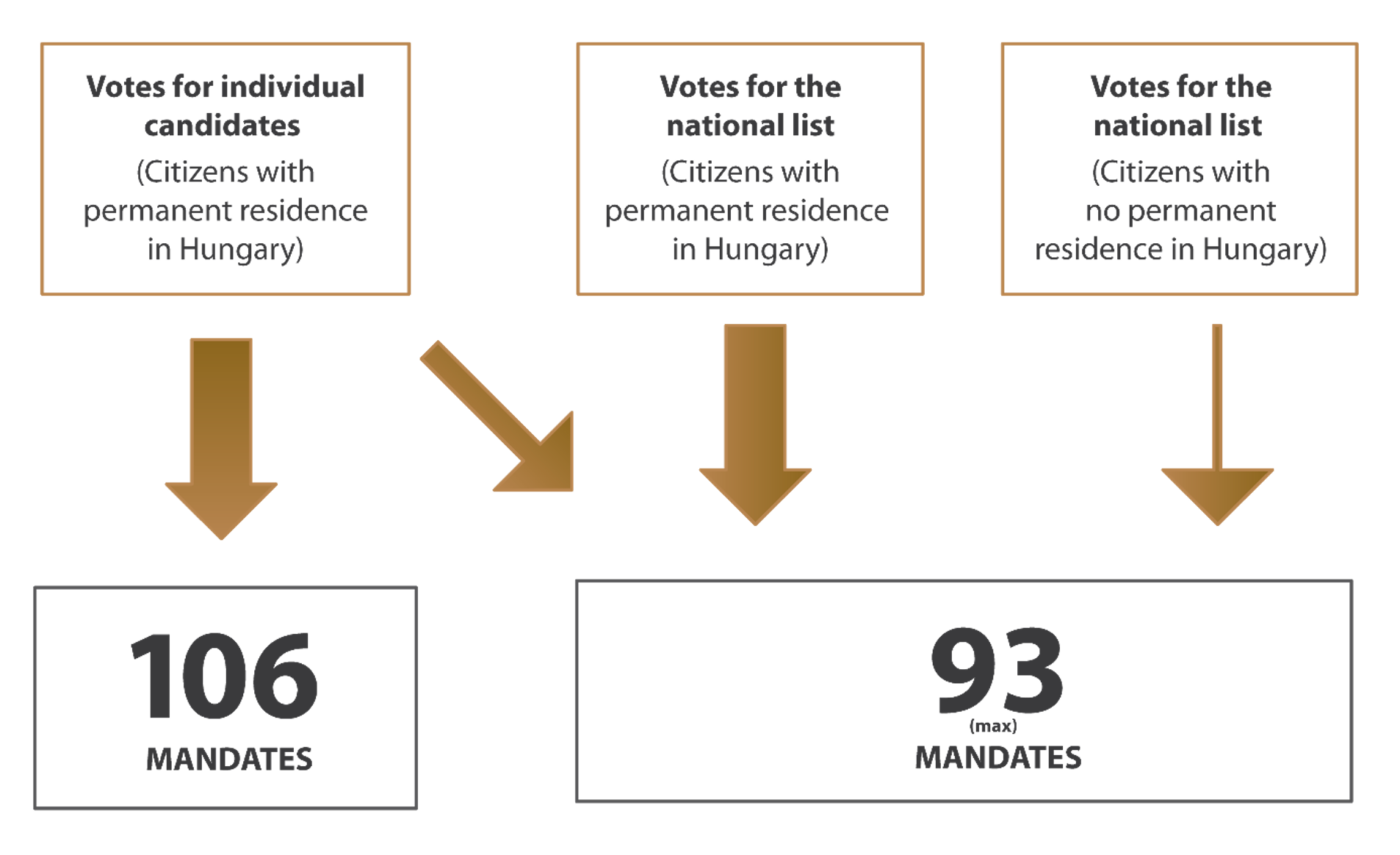
106 MPs gain a seat in the National Assembly from single-member constituencies. 93 MPs get their seats from national party lists.
Parliamentary seats from single-member constituencies
Since there is only one round in the election, the candidate with the relative majority of votes wins the seat in each of the 106 single-member districts. Thus, they need not obtain at least 50% of the vote.
Parliamentary seats from national party lists
Parties and party alliances can gain seats from their national lists if they obtain a certain percentage of the ballots cast. For individual parties, the threshold is 5%, for two parties competing jointly it is 10%, and in the case of three or more parties, the parliamentary threshold is 15%. The votes cast on lists that fail to reach the threshold are not used further in the seat allocation process.
As the graph below shows, votes that are turned into parliamentary seats come from three sources (the thickness of the arrows indicates the number of votes in the given category compared to the others):
- Votes cast for party lists by those with a registered Hungarian address;
- Votes cast for party lists by those without a registered Hungarian address (mail-in votes of out-of-country Hungarians);
- Surplus votes, which are generated from votes cast on single-member candidates
The process of converting votes into parliamentary seats
Surplus votes
Some of the votes cast on candidates in single-member constituencies are added to votes cast on national party lists in the form of surplus votes. The example below (entirely made-up) helps to understand the process:
- 1st place candidate: 20,000 votes
- 2nd place candidate: 15,000 votes
- 3rd place candidate: 10,000 votes
- 4th place candidate: 5,000 votes
The candidate who receives 20,000 votes gains the seat in the district. As votes for losing candidates are not used, these votes are added to the respective party's national party list vote pool as compensation for the candidates. Thus, the party of the second-place candidate receives 15,000 fragment votes, the party of the third-place candidate receives 10,000, and the party of the fourth-place candidate receives 5,000 (but only if the party passes the parliamentary threshold; otherwise, these votes are not used).
The winning candidate's party can also gain surplus votes, which is why the difference between the candidates in first and second place in single-member constituencies matters. In our example, 15,001 votes would have won this constituency. As the first-place candidate received 20,000 votes, the 4,999 surplus votes that were not required for victory are added to their party's national list vote pool.
Distributing votes on national party lists
In general, around 4.5 million national party list votes are used depending on the turnout rate and the proportion of lost (unused) votes. Since surplus votes are generated in all 106 single-member constituencies (after each winning and losing candidate), millions of surplus votes are also collected. The number of votes cast by out-of-country Hungarians is in the hundreds of thousands. In the 2018 general election, the final tally included about 5.1 million votes cast in Hungary and 223,000 votes cast by out-of-country Hungarians, as well as around 3.5 million surplus votes, as shown below:
Votes converted to party list seats in the 2018 general election:
Since only a maximum of 93 party list seats can be distributed, the votes gathered by party lists are by default divided into 93 parts in a (mostly) proportional manner. (In 2018, only 92 seats were handed out; see the explanation under Preferential parliamentary seats from ethnic lists.)
Party list seats are distributed based on the d’Hondt-matrix method in the following manner. We enter the name of political parties which passed the parliamentary threshold in the header of a chart. On the vertical axis, we list natural numbers starting with ‘1’. In the first row of the table, we indicate the number of votes collected by national party lists based on the above-mentioned method (party list votes from within and outside of the borders + surplus votes), then half of this number in the next row, a third of them in the third row etc. The first party list seat is given to the party with the highest number in the chart. We select this number and then go to the largest of the remaining numbers, and the party that achieved this number receives the second seat. We continue doing this until all party list seats are distributed.
Party list seats distribution based on D'Hondt-matrix (based on the 2018 general election results)
Party list seats distribution after the 2018 general election
Preferential parliamentary seats from ethnic lists
Hungarian citizens belonging to any of the 13 registered ethnicities in Hungary can decide to vote for a nationality list instead of the national party lists. They still have two votes, just like any other Hungarian citizen (one for their single-member constituency candidate and one for the nationality list).
The nationality lists are compiled by ethnic self-governments in Hungary; so, a voter choosing to vote as a nationality receives a ballot with only a single list on it.
Theoretically, all nationalities may receive a preferential parliamentary seats, but only the Roma and the German nationalities stand a real chance due to their numbers. The seat is preferential because they are required to gather substantially fewer votes for a parliamentary seat than national parties (a quarter of the latter). They are calculated in the following manner:
We add up the number of votes cast on national parties that passed the parliamentary threshold and the ballots cast on nationality lists (including surplus votes). The sum is then divided by the maximum possible number of parliamentary seats earned from national party lists (93), which as a result gives us the average number of votes required for a party list seat. This value is then divided by four, which shows us how many votes are required for a preferential parliamentary seat (this is the preferential quota). The nationality list that obtained at least this many votes gets a preferential parliamentary seat. The number of seats distributed from national party lists is reduced by the number of ethnic lists that obtained a preferential seat (to ensure that the National Assembly has 199 MPs). The leaders of the lists that gathered fewer votes than the preferential quota get a seat in the Assembly as “nationality spokespersons”, meaning that they do not receive a full mandate, and they do not count as MPs.
In 2014, the German minority list received 11,415 votes, 26,477 in 2018, and 24,630 in 2022. In the latter two elections, these figures exceeded the preferential quota, which entitled the German minority to obtain a preferential parliamentary seat.
None of the other twelve minority lists came close to reaching the preferential quota; in fact, the National Roma Self-Government did not even present a list in 2022.
This short guide is a neutral description of the Hungarian electoral system, and specifically how votes are converted into parliamentary seats.
We track the changes in the number of voters registered in the minority electoral registers, the postal voting register, and the foreign mission voting register at the respective links until the day of the 2026 parliamentary elections.
Our election-related materials can be found here (EN, HU).
.