
Political polarization and tribalism on the verge of a two-party system
Key research findings
Many people think there will be some type of election fraud. Although willingness to vote is very high (85%) and almost as many believe that participating in the upcoming election is more important than in the last 2022 election (80%), a notable proportion (28%) believes that the electoral authorities will not conduct the election fairly. 63% expect the government to tamper with the election rules, and 48% even expect the governing Fidesz to commit some form of electoral fraud in order to retain power.
"We" are the good guys, "they" are the bad guys. The overwhelming majority of supporters in both Fidesz and TISZA camps regard voters of the rival party as blind followers who believe everything their leader says without question (66% and 89%, respectively). Moreover, a significant majority of voters in both camps assume that members of the other camp pose a serious threat to the country and the Hungarian people (65% and 55%, respectively).
Although enhancing polarization is evident in many respects, significant differences remain between the supporters of the two dominant parties. The Fidesz camp is much more tribal than the TISZA camp, which is unsurprising given that, in contrast to the ruling party, which has existed for decades and exerts significant influence over its voters, TISZA was established only a year and a half ago, and its supporters are considerably more heterogeneous. Half of Fidesz voters say they would not vote for another party even if Fidesz could not run for some reason, while only 19% of Tisza voters are that committed, as the majority have a variety of secondary party preferences.
We are more violent than we were four years ago. While politically motivated physical violence has been rare in Hungary, verbal abuse has been common. The majority of almost all voter groups perceive politics as having become more violent, partly due to the prevalent verbal violence and partly due to the radicalization of politicians' communication. 69% of all voters perceive politics as more violent than it was four years ago. Unsurprisingly, when it comes to the question of responsibility, supporters of both major political parties point the finger at the opposing party’s leader.
It is more challenging for Fidesz to appeal to undecided voters. The increasingly intense campaign is primarily aimed at winning over the shrinking number of undecided voters. While demographic factors suggest that the composition of the undecided voters aligns more closely with Fidesz voters than TISZA voters, the ruling party's rejection rate among the undecided voters is currently significantly higher (41%) than TISZA’s (16%), and about three-quarters of them believe that things are generally going in the wrong direction.
Background
Terminology
The primary idea behind tribal thinking, or tribalism, is that political camps rally around their own leaders while sharply rejecting the other tribe. Tribalism is characterized by a Manichaean worldview, a black-and-white way of thinking that divides the world into good and evil, and by authoritarianism, which puts trust in a strong leader. This is not merely a matter of political differences, but rather an antagonistic opposition that hinders dialogue and leads to “cold civil war” scenarios that are more intense than political disagreements. When tribal thinking shapes public sentiment, the stakes of an election increase dramatically, and members of opposing camps feel that everything will be over if the other side wins.
The rise of tribal thinking in politics is by no means a Hungarian phenomenon. In fact, in many countries, it has led to harsher and more violent conflicts than in Hungary. In the United States, for example, polarization is more acute in many ways, and political differences appear more irreconcilable than in Hungary.
Shifting political environment
After decades of fragmentation, the Hungarian party system has once again become a two-party system, and this transformation has taken place at an unprecedented speed, in less than a year. Following the rise of Péter Magyar and his TISZA, most opposition voters are now united behind a single large party and political leader. In our research, we were primarily interested in how social and political polarization can be characterized in this context.
Methodology
The data collection was carried out by Medián on behalf of Political Capital between 29 October and 13 November 2025, using telephone interviews with a sample of 1,000 individuals aged 18 and over, representing the country's population. Minor distortions resulting from random sampling were corrected by weighting based on census data from the Hungarian Central Statistical Office. This ensured that the sample accurately reflected the demographic composition of the voting-age population (by gender, age group, educational attainment, and urban/rural location).
Undecided voters
Undecided voters are likely to play a pivotal role in the upcoming election, and both parties are clearly trying to appeal to this group. Consequently, our analysis consistently presents the results for this group alongside those for the two dominant parties.
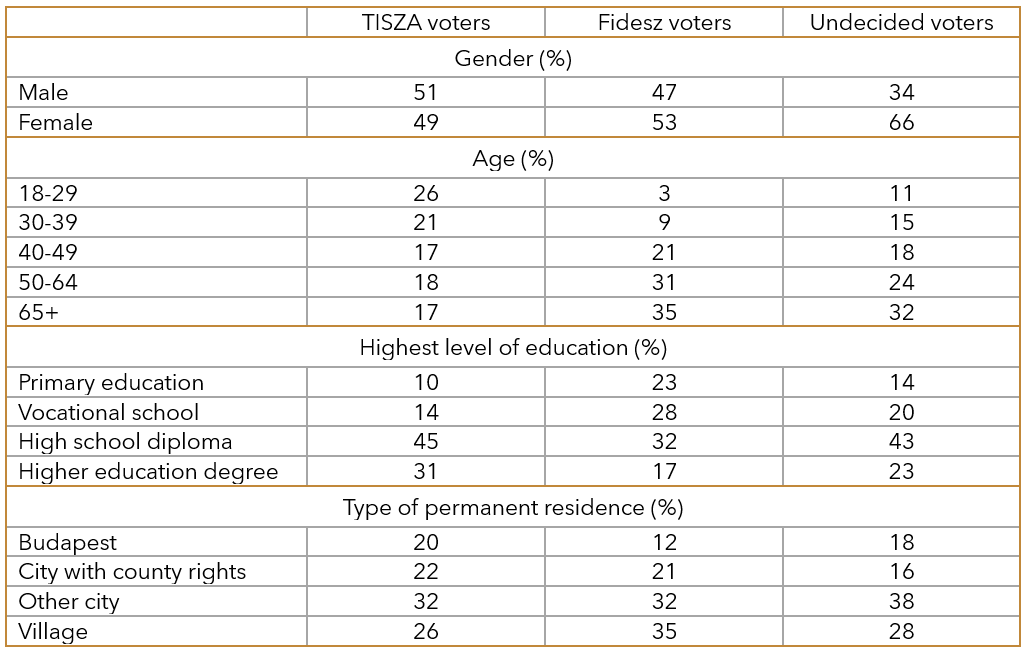
The group of undecided voters includes respondents who either do not know or do not disclose which party they would vote for. However, this group excludes those who are not politically engaged and who, in the party preference question, confirmed they would not vote. As the table below shows, the demographic profile of undecided voters more closely resembles that of Fidesz voters than of TISZA voters.
The demographic composition of voters for the two dominant parties and the undecided voters in the research sample
Unprecedented willingness to vote
The first sign of heightened political engagement is the extremely high inclination to participate in the 2026 parliamentary elections: 85% of respondents indicated that they would definitely vote, and another 12% said they would probably vote. As a reminder, voter turnout in the last two elections (2018 and 2022) was exceptionally high at 70.2%. Only the 2002 elections had a higher turnout, with 70.5% in the first round and 73.5% in the second round. The latter is not a national figure, as the second round was necessary in 131 of the 176 individual constituencies.
Of the two dominant parties, TISZA voters appear to be more engaged, with 95% of them indicating their willingness to participate in elections, compared to 86% of Fidesz voters.
The willingness for electoral participation has increased because the vast majority of voters consider the upcoming elections very important. 85% of voters from the two major parties believe it is more important to participate in the upcoming elections than in the 2022 elections. In the full sample size, 80% of respondents shared this belief, and even two-thirds of those uncertain about their party preference perceived the stakes as high.
Many people do not believe that the election will be fair and transparent.
Although willingness for electoral participation is high, a relatively large proportion of respondents believe the electoral authorities will not conduct the election fairly. In the total sample size, 28% share this view. Unsurprisingly, Fidesz supporters are much more confident that the elections will be fair and transparent, while opposition voters are more skeptical. Less straightforward is that undecided voters are almost as distrustful (36%) as TISZA voters (39%).
At the same time, it is perfectly understandable that many voters hold seemingly contradictory views. Some may feel that the integrity of the election is at risk due to the high stakes involved, and believe that electoral participation will make the outcome less susceptible to influence.
Given that Fidesz, with its two-thirds majority in parliament, has often changed the electoral system to suit its own interests in the run-up to elections in recent years, it is hardly surprising that the majority expects electoral tinkering again. 63% of all respondents, 90% of TISZA voters, 63% of undecided voters, and even a quarter of Fidesz voters are certain that Fidesz will change the electoral rules before the 2026 elections.
48% of respondents expect the governing Fidesz to commit electoral fraud in order to retain its hold on power, reflecting a serious lack of trust. 79% of TISZA voters expressed concerns over electoral fraud, confirming public reports indicating that this concern is a recurring matter on TISZA’s public forums. Undecided voters are largely divided on the matter, but even among Fidesz voters, a visible fraction, 7% of them, expect their own party to commit some form of electoral fraud.
When asked whether TISZA would commit election fraud, fewer than half as many respondents consider it a likely scenario as those who believe Fidesz would. While 48% expect Fidesz to commit electoral fraud, only 22% expect TISZA to do so. 79% of TISZA voters and 50% of Fidesz voters expect malicious interference from the other side. The difference could be attributed to the government’s significantly greater resources and tools available for such purposes. This could also explain the striking difference among undecided voters: more than four times as many (46%) believe Fidesz would commit fraud as those who expect malpractice from TISZA (11%).
We also inquired about a specific fear that is frequently discussed, and the results confirmed that many people anticipate such a move: the proportion of those who assume that Fidesz will somehow prevent Péter Magyar or his TISZA from running in the election is particularly high. In the full sample, 41% of respondents consider this probable. While 16% of Fidesz voters, 58% of TISZA voters, and 48% of undecided voters assume this is probable.
Party preferences are becoming increasingly polarized
Moving beyond general questions about the election and examining party preferences instead, it appears that the Hungarian party system is becoming increasingly bipolar, a finding that is consistent with the results of other opinion polls. In the total sample of 1200 respondents (including the 200 respondents who answered the party preference question at the beginning of the questionnaire but later did not complete their responses), TISZA had a voter base of 39%, Fidesz had 32%, Our Homeland (Mi Hazánk) had 4%, and Two-Tailed Dog Party (MKKP) had 3%, and Democratic Coalition (DK) had 2% at the time of data collection. The overall proportion of undecided voters was 19%. (These proportions changed minimally by the time Medián published its survey at the end of November. The data for the present study were collected between 29 October and 13 November, while the data for the Medián study, published on 26 November, were collected between 20 and 25 November.)
However, our current focus is on the degree of polarization rather than the popularity of individual parties. The emergence of the two dominant parties, coupled with the gradual erosion of smaller parties, also points to an emerging division.
Secondary part preferences also reflect on emerging polarization. When asked which party they would vote for if they were unable to vote for their primary preference, 31% of respondents said they would not vote for any other party. Of those who stated they would vote for another party, 17% chose the MKKP, 16% selected Mi Hazánk, while 7% opted for DK. 4% or less of respondents mentioned other smaller parties.
Fidesz has the most loyal voter base, with half of its voters so committed that they have no secondary preference, 30% would vote for Mi Hazánk, and only a negligible proportion (1-2%) mentioned other parties.
By contrast, a significantly smaller proportion of TISZA voters (19%) would not vote for another party. By far the most popular secondary preference is MKKP, chosen by 31% of TISZA voters, followed by DK (14%), Mi Hazánk (8%), Momentum (7%), Everybody's Hungary People's Party (MMM) (5%), and Second Reform Era Party (2RK) (4%). This illustrates the heterogeneous background of the TISZA camp and the extent to which the party has lured voters away from smaller opposition parties.
Dispreference also provides insights into the extent of polarization. The two dominant parties clearly consider each other their biggest competitors. 81% of Fidesz supporters said they would definitely not vote for TISZA, and 90% of TISZA voters said the same about Fidesz. The increasingly intensive campaign is aimed at convincing the shrinking group of undecided voters, among whom rejection of the ruling party currently significantly outweighs rejection of TISZA (41% versus 16%).
As might be expected, supporters of the two dominant parties have radically different views on the direction in which the country is heading. While 89% of Fidesz supporters believe that things are going in the right direction, 98% of TISZA supporters think that they are going in the wrong direction. Of the full sample, twice as many voters believe things are going in the wrong direction (64% versus 32%). Undecided voters tend to share the views of opposition voters, with 76% holding an unfavorable view of Hungary's direction.
"We" are the good guys, "they" are the bad guys
Although enhancing polarization is evident in many respects, significant differences remain between the two dominant parties. The Fidesz camp is much more tribal than the TISZA camp, which is unsurprising given that, unlike the ruling party, which has existed for decades and exerts significant influence over its voters, TISZA was established only a year and a half ago, and its supporters are considerably more heterogeneous.
The extent of polarization and tribal thinking is reflected in how voters of one party perceive supporters of other parties. Fidesz voters have the most negative and dismissive perception of supporters of “others.” They view TISZA, DK, and MKKP voters with almost equal antipathy, and only view Mi Hazánk supporters slightly more favorably.
TISZA voters assess other parties' voters in a differentiated way. They perceive significant differences among the parties, but they tend to overestimate their own camp while dismissing their main rival. Undecided voters have far less diverse views and tend to be neutral in their opinions of the various parties’ voters. This may explain why Fidesz is seeking to change its style and appeal to nonpartisan voters with a more subdued tone.
If we look at how Fidesz and TISZA supporters view each other, the overwhelming majority in both camps regard voters of the rival party as blind followers who believe everything their leader says without thinking.
Prime Minister Viktor Orbán has repeatedly described opposition voters as misguided, a view shared by two-thirds of his supporters. This opinion is even stronger among TISZA voters, only in the opposite direction: nine out of ten believe that Fidesz supporters blindly and unquestioningly believe whatever they hear from their leaders.
More concerning is that the majority of both dominant parties believe that members of the other camp pose a serious threat to the country and the Hungarian people. 65% of Fidesz voters hold this view about the rival party, compared to “only” 55% of TISZA voters. Interestingly, the proportion of Fidesz supporters who regard the opposing party as blind followers or dangerous is roughly the same (66% and 65%, respectively), but there is a significant difference among TISZA supporters (89% and 55%, respectively).
26% of all voters view politics as a battle between good and evil. This perception is most prevalent among Fidesz voters (37%), followed by TISZA voters (18%). Among undecided voters, it stands at 27%, corresponding to the national average.
Currently, 15% of Hungarians believe that it is possible to determine whether a person is good or bad solely based on their political affiliation. This perception is shared by 22% of Fidesz voters, 12% of TISZA voters, and 18% of undecided voters.
In light of the responses to the preceding questions, the latter two proportions cannot be considered high. The most plausible explanation is that these are much more abstract questions. Politicians (as well as individuals in the comments sections) frequently discuss the blind faith and violence of the opposing side. In other words, politicians shape their supporters’ views on the opposing side. By contrast, the latter question is much more abstract and does not typically appear in political discourse. Therefore, when an interviewer asks it, respondents do not give an immediate, instinctive answer. Rather, they must form an independent opinion, which tends to be more moderate.
An instructive reflection of tribal thinking is the number of people who would support a strong-handed leader making decisions instead of elected politicians. A quarter of all respondents (26%) believe that the country would experience greater success under such an arrangement. This proportion is 31% among Fidesz voters, 18% among TISZA supporters, and 35% among undecided voters.
At first glance, it may not seem entirely logical that undecided voters would show the most support for authoritarian leaders. However, it is important to take into account that a significant proportion of them are undecided due to their distrust of politicians and parties. This may explain why they are the ones who want a strong leader.
Regarding personality traits examined in the study, Fidesz supporters viewed TISZA supporters as more violent than the other way around. In fact, Fidesz supporters consider themselves to be particularly peaceful. TISZA voters, however, view Fidesz supporters as violent almost to a similar extent, while describing their own camp as peaceful. Undecided voters see the Fidesz camp as slightly more violent, but they typically place voters of both major parties closer to the middle.
We were also interested in examining the extent to which politics influences preferences that, in theory, are independent of it. To that end, we asked how members of each camp would react if an artist they liked publicly supported the opposing camp. In such a case, most of Fidesz and TISZA supporters said they would hold their favorite celebrity in lower regard. 63% of Fidesz supporters and 70% of TISZA supporters share this viewpoint.
The two dominant parties showcase relatively strong internal cohesion. However, our study revealed that the TISZA is more heterogeneous than Fidesz. Supporters of the two major parties feel, to a similar extent, that their way of thinking is similar to that of other supporters of their preferred party. However, there are significant differences between the two camps in how they react to external views of their party. 83% of Fidesz supporters feel good if people say nice things about their party, compared to 63% of TISZA supporters. Meanwhile, 44% of Fidesz supporters say they become very angry when criticized, compared to only 27% of TISZA supporters who share this sentiment.
Overall, tribal thinking significantly shapes Hungarian politics. The responses indicate that this attribute is more prevalent among Fidesz supporters, suggesting stronger internal cohesion and a more critical view of voters from the opposing side than TISZA supporters.
Although there is no physical violence, there is a palpable sense of danger.
Political polarization in Hungary has so far rarely been marred by violence. Recently, numerous large street protests have taken place peacefully, with supporters of the two dominant political parties demonstrating in the same city and sometimes even in close proximity to each other. While there has been no physical violence, there have been several incidents of verbal abuse, heated exchanges, and vandalism. The majority of almost all voter groups perceive politics as becoming more violent, partly due to these incidents and partly due to the radicalization of politicians' behavior and communication. 69% of voters perceive politics as more violent than four years ago. TISZA voters are well above average in this regard (81%), while Fidesz voters are slightly below average (60%).
As expected, supporters of the two dominant parties point the finger at the other party's leader when it comes to the question of responsibility. However, Fidesz voters take a more nuanced view of this issue, with 15% believing that both sides are responsible for the escalation. The majority of the entire sample (55%) holds Prime Minister Viktor Orbán and Fidesz responsible for politics becoming more violent, while only 26% blame Péter Magyar and TISZA. Even among undecided voters, there is a strong perception that Fidesz is responsible.
Fortunately, only a few respondents reported experiencing a physical attack because of their political views. However, about 10% said they had felt physically threatened. Among the entire sample, 39% of respondents said they had been insulted because of their political views. This applied to 35% of Fidesz voters and 50% of TISZA voters.
Please see our studies examining polarization, tribalism, and attitudes toward political violence below.
- Péter Krekó: Populism in power: The tribal challenge (2021)
- Beyond populism – tribalism in Poland and Hungary (July 2018)
- Measuring Political Violence (October 2015)