
The Desire for Change Swept Away the Orbán Regime Trapped in Its Own Information Bubble
TISZA won a historic electoral victory over Fidesz, which will have far-reaching consequences for the Hungarian political system, as well as internationally. The 2026 Hungarian parliamentary elections revealed the limitations of an informational autocracy.
The Balance of Power
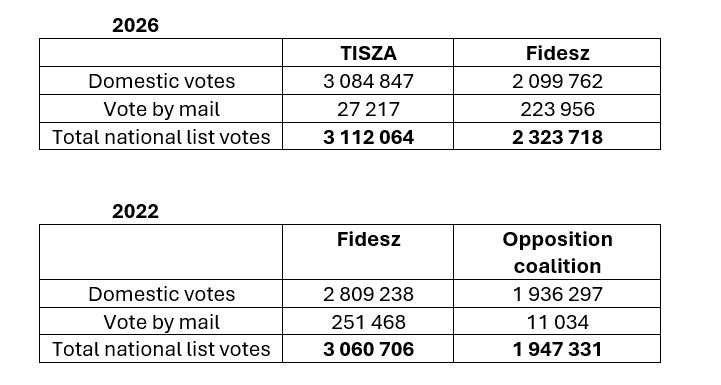
In the recent parliamentary election on 12 April, the opposition TISZA party secured the largest mandate ever, winning the highest number of votes and proportion of parliamentary seats. This was a significant victory over the ruling Fidesz party, which won a two-thirds supermajority four times between 2010 and 2022. Péter Magyar’s party currently holds 136 of the 199 seats in parliament, a figure which could rise to 139 or even 140 once votes cast at foreign embassies and by voters registered outside their home constituencies are counted on 18 April. These votes will be added to the 'Domestic Votes' category in the table below. In recent elections, they have tended to favor the opposition.
A record was also set for votes cast for the national list: at least 3.1 million people voted for TISZA, a figure which could increase by a further 100,000–200,000. Of the 3.1 million voters, only 20,000 were out-of-country Hungarians who vote by mail. Fidesz's domestic support is expected to total around 2.2–2.3 million votes, which is only around 300,000 more than the six-party opposition coalition received in 2022. Fidesz's best-ever performance was in 2022, when it received 3.06 million votes, 2.8 million of which were cast domestically.
National list votes of the two largest parties in 2022 and 2026 (with 98.93% of votes counted)
Expected Domestic Political Consequences
Péter Magyar intends to form his government as quickly as possible. The National Election Commission must certify the official final results by 4 May. The new National Assembly must then be convened by 12 May. It is only at this point that the outgoing parliament’s mandate will expire and the Orbán government will become a caretaker administration. The new parliament will then elect the prime minister, who will appoint the members of their cabinet. As no coalition talks are required, the process will be shaped entirely by internal dynamics within TISZA; consequently, the new government could be in place by the end of May.
While the two-thirds supermajority enables deep institutional reform, this also carries risks for TISZA. Rapid institutional overhaul and swift assertion of complete control over the state apparatus will raise voter expectations regarding specific policy areas and rapid improvement in public services. Meanwhile, economic constraints will be significant. One of the new government's initial steps will be to restore anti-corruption and rule-of-law institutions, as these are prerequisites for Hungary to access the billions of euros in EU cohesion and recovery funds withheld due to concerns about the rule of law and corruption under the Orbán regime. The new government must act on this front by August. Additional priorities will likely include reforming the Fidesz-organized state media apparatus, dismantling the Fidesz propaganda machine and restructuring institutions.
Although Péter Magyar promised swift leadership changes at key institutions, including the Office of the President of the Republic, the Kúria (Hungary’s highest court), the Office of the Prosecutor General, the Constitutional Court, the Media Authority, the State Audit Office and the Hungarian Competition Authority, if the incumbents refuse to resign voluntarily, this could lead to a protracted constitutional dispute and uncertainty. The speed of these changes may also depend on how effectively Viktor Orbán can exert his influence over his appointees, since retaining these positions is in his fundamental interest. However, if any institutional leader refuses to step down, the new government can apply significant political pressure. It is also possible that institutional leaders who were loyal to Fidesz until now may gravitate towards the new government. This dynamic would be further reinforced by the fact that TISZA, with its two-thirds majority, could remove unwanted institutional leaders through constitutional amendments — or even an entirely new constitution.
Péter Magyar will only be able to fulfil his campaign promises regarding the rule of law if he appoints individuals who are truly autonomous to lead government-independent institutions. Without this, it will be difficult to speak of genuine regime change. Real transformation can only occur if the hollowed-out independent institutions are restored to a state where they genuinely constrain executive power.
In the new political landscape, the bandwagon effect is likely to further weaken and partially disintegrate Fidesz in the short term, especially if legal and political accountability is enforced, which the majority of TISZA voters are demanding. There would be clear grounds for such proceedings in numerous cases. A mass exodus from Fidesz's clientelist network could follow, with many people discovering their inner dissident retroactively, as happened when the communist Kádár regime collapsed in 1989.
The reorganization and recovery of Fidesz will also be complicated by the parliamentary presence of Mi Hazánk (Our Homeland), who could compete with the former ruling party in the opposition. An alternative to TISZA could emerge outside parliament, and different factions could form within the party itself in the medium term.
The TISZA government will have severely limited economic scope for maneuver, but greater confidence and expectations among economic and market actors, along with the anticipated arrival of EU funds and anti-corruption measures, could expand this scope to some extent. The significant interest burden on the country may also decrease (the forint has already begun to strengthen).
Expected Foreign Policy Consequences
The strong mandate will enable the TISZA government to implement a more decisive shift in foreign policy. Relations with European allies could improve quickly, and by meeting anti-corruption and rule-of-law conditionality, Hungary could gain access to EU funds. However, despite its constructive EU and NATO membership, TISZA is likely to provoke symbolic conflicts with the EU on certain issues. This is to demonstrate the promised foreign policy course that stands apart from the European mainstream, and to counter Fidesz’s attempts to label TISZA as EU puppets during the campaign.
TISZA does not support Ukraine’s accelerated EU accession, and improvement in Ukrainian–Hungarian relations is expected to happen gradually. In terms of regional relations, the TISZA government is seeking a close alliance with Poland and Austria. It is no coincidence that Péter Magyar’s first two trips will be to Warsaw and Vienna. A pragmatic relationship with the Czech Republic is anticipated, whereas relations with Slovakia could be more contentious due to the Beneš decrees, which authorized the confiscation of property and collective punishment of ethnic Hungarians in post-war Czechoslovakia and remain a sensitive issue in Hungarian–Slovak relations. There is also the potential for a foreign-agent law in Slovakia to cause further tension. Regarding the relationship with the United States, Péter Magyar was careful not to criticize Donald Trump during the campaign, but the question remains whether Washington will want to rewrite the friendly relationship it has cultivated with Viktor Orbán overnight.
Even if it does not sever all ties, the new government will begin to distance itself decisively from Russia, including in the energy sector. This will strengthen the country’s energy security and represent the first step towards rebuilding trust with Western partners. However, it would be unrealistic to expect Russian influence to disappear overnight. The Kremlin is keen to weaken the new government. Both Fidesz and Mi Hazánk could become prominent platforms for advancing Russian interests in Hungary. At the same time, Russia will likely try to court the new government as well. An equally important signal would be if the Kremlin were to distance itself from Fidesz.
Although relations with China are unlikely to change significantly, Hungary may become more cautious and align its policy more closely with the EU's overall approach to China.
The defeat of Fidesz will also have an impact on the global political network of the so-called autocratic Internationale and illiberal regimes in general. Not only was Viktor Orbán a role model and template for parties and politicians belonging to this network, but his regime also provided extensive practical assistance and support to these actors in pursuit of their common goal of weakening the EU. The defeat of the Orbán regime, which was long considered a model to follow, calls into question the viability of illiberal solutions and models. It offers important lessons for democratic and pro-EU forces and could thus curb or at least challenge the advance of illiberal systems in Europe and beyond.
The Causes of the Orbán Regime’s Fall
Like all informational autocracies, the political structure of the Orbán regime rested on the continuous demonstration of a social majority. However, if this majority erodes to the point where popular dissatisfaction can no longer be concealed, the system can collapse.
One of the main reasons for losing the majority was the economic crisis facing the regime. Since autumn 2022, most Hungarian voters have experienced a decline in living standards, with growth stalling and the EU’s highest inflation eroding purchasing power from 2023 onwards. Public services such as healthcare, education, transport and the social safety net deteriorated severely. Across diverse social groups, the majority of voters no longer felt it was in their interest to sustain the system. The desire for stability was overridden by the desire for change, particularly among young people who turned out in large numbers to vote in the election.
A decisive factor was that the majority of people who were dissatisfied with the government did not remain unorganized. From spring 2024 onwards, Péter Magyar and TISZA presented such a powerful anti-elite political alternative to Viktor Orbán and Fidesz that the regime was unable to fracture or weaken. The combination of a strong leader with a grassroots, rural-based movement behind him created a unique situation in which the opposition was able to win despite the deeply unequal competitive conditions.
Interestingly, Péter Magyar rode a populist wave against Orbánism, which had been in power for 16 years and had constantly pointed to external enemies, but had proved incapable of continuing to play the anti-establishment role. The Orbán regime itself became the rejected elite in Hungary, and the majority of Hungarian voters voted to replace it.
The ideological foundation of the Orbán regime also crumbled. Over the past two years, the regime has been characterized by intellectual hollowing out, child protection scandals (the most significant of which was the 2024 clemency scandal, involving the Hungarian President and Justice Minister pardoning a man convicted of covering up child sexual abuse at a children’s home), the abandonment of national interests and total subordination to Russian interests. These factors have eroded the regime’s credibility and the very foundations of its ideological self-definition (pro-family and sovereign).
These kinds of authoritarian regimes maintain power not through violence, but through informational tools. However, the effectiveness of these tools is finite. As demonstrated in Political Capital's March research, the Orbán regime's information machinery was unable to override the significant social dissatisfaction channeled by TISZA, and its reach and effectiveness declined. Traditional political tools such as cross-country campaign tours, which enable personal contact with voters, proved more effective than the regime’s informational tools. Meanwhile, Fidesz and its shrinking support base became detached from reality, becoming trapped in their own information bubble. Consequently, the electoral defeat took even the regime’s own elite by surprise.
Reminiscent of the pre-1989 era, Russian influence was also unable to keep the Orbán regime in power. As we previously wrote, the question was not whether Russia would intervene in the election, but whether such intervention would be successful. Ultimately, this too was unable to override dissatisfaction with the government in Hungary, aided significantly by investigative journalism that revealed the true extent of the Russian-Hungarian relationship.