
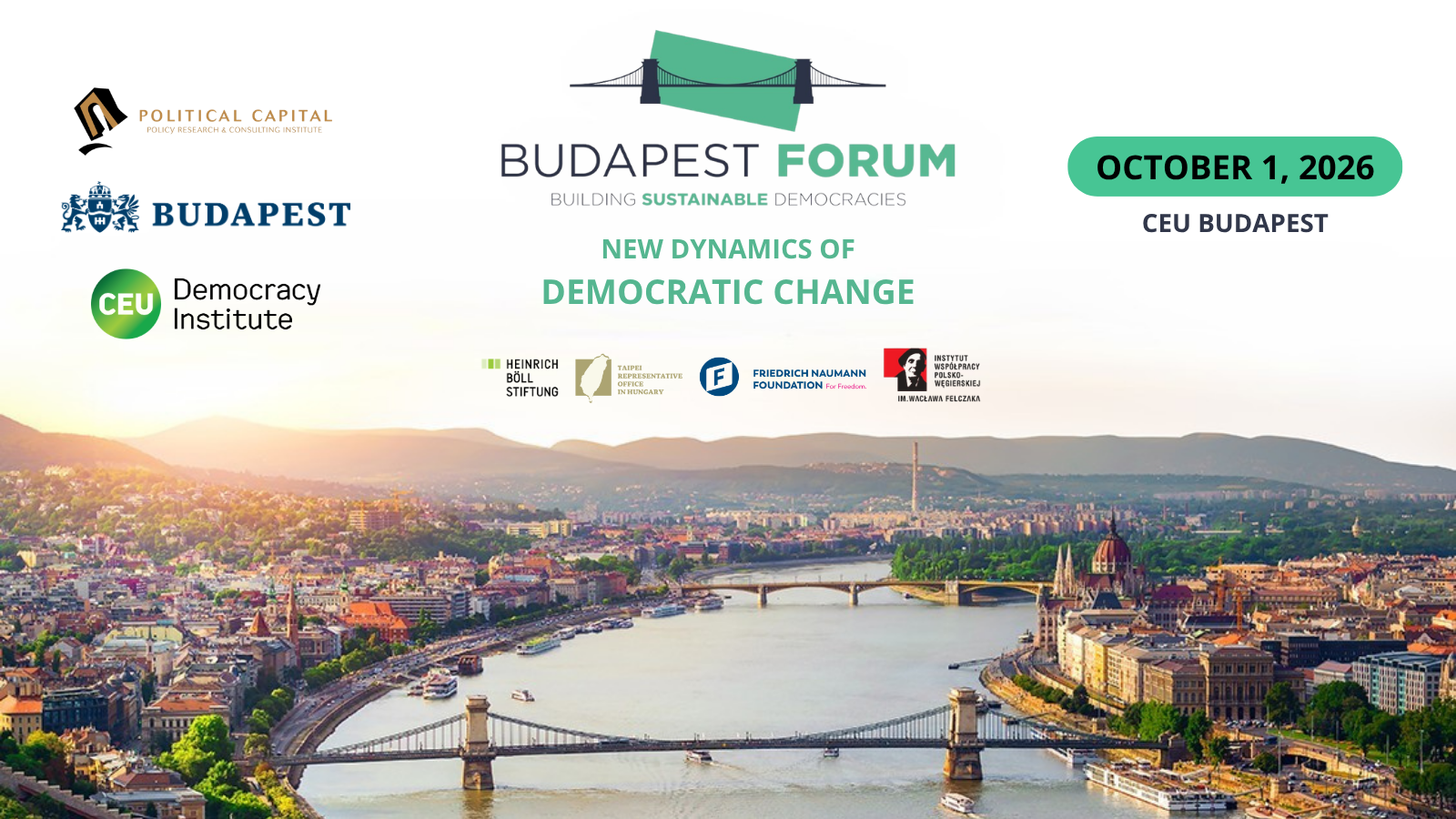
Budapest Forum 2026 - New Dynamics of Democratic Change
In recent years, however, a new political dynamic has emerged. In countries such as Brazil, Poland, and, most recently, Hungary, illiberal governments have been defeated through democratic elections. These developments suggest that illiberalism is neither politically invincible nor capable of providing lasting answers to the structural challenges confronting contemporary societies. Despite concentrating power, controlling institutions, and mobilizing powerful political narratives, illiberal governments have ultimately struggled to deliver sustainable solutions.
Yet electoral victory marks only the beginning of a far more demanding process. Societies emerging from prolonged illiberal rule must rebuild democratic institutions, restore trust, strengthen the rule of law, renew political competition, and develop a new social contract. There are few established models for democratic renewal after illiberalism, and the current international environment offers limited political or intellectual guidance.
Against this backdrop, the Budapest Forum 2026 will examine the opportunities and dilemmas of governing after illiberalism. Using Hungary as its point of departure while placing it within a broader European and global context, the conference will explore how democracies can renew themselves after prolonged democratic erosion.
Key topics and speakers
Hungary after illiberalism – rebuilding democratic institutions and reintegrating Hungary into Europe
How can democratic institutions be rebuilt after prolonged democratic erosion? With Kim Lane Scheppele, Laurance S. Rockefeller Professor of Sociology and International Affairs, Princeton University; Renáta Uitz, Senior Research Fellow, CEU Democracy Institute; and Zoltán Fleck, Professor, Eötvös Loránd University. Moderated by Péter Krekó, Political Capital Institute.
Can Central Europe find a common response to today’s crises?
With Jakub Stefaniak, Secretary of State, Chancellery of the Prime Minister of Poland; Dominika Hajdu, Director for Policy and Programming, GLOBSEC; Botond Feledy, Director, Hungarian Institute of Foreign Affairs; Jakub Wisniewski, Director, Waclaw Felczak Institute for Polish-Hungarian Friendship; and Zoltán Varga, CEO, Central Media Group. Moderated by Zsuzsanna Szelényi, Program Director, CEU Democracy Institute.
Europe’s 2027 electoral turning point – populism, fragmentation and the future of mainstream politics
Looking ahead to Europe’s key electoral battles with Dániel Hegedűs, Deputy Director, Institut für Europäische Politik; Jean-Yves Camus, Research Fellow, Institut de relations internationales et stratégiques; and Leszek Jażdżewski, Editor-in-Chief, Liberte! and Vice-President, Fundacja Liberte!.
Washington, Brussels and Taipei – security in a changing world
Exploring the shifting global security landscape with I-Chung Lai, President, Prospect Foundation, Taiwan; Ivana Karásková, China Team Lead, Association for International Affairs; Roland Freudenstein, Martens Center; and Tamás Csiki Varga, Senior Research Fellow, John Lukacs Institute for Politics and Strategy, Public Service University. Moderated by Bernadett Szél, Research Affiliate, CEU Democracy Institute and 2025 MOFA Taiwan Fellow.
Cities under pressure – municipal resilience in an age of overlapping crises
How can cities respond to overlapping political, social and economic pressures? Featuring Femke Halsema, Mayor of Amsterdam, Kata Tüttő, President of the Committee of the Regions and Thomas O. Melia, Senior Fellow, Georgetown University, Former Assistant Secretary of State. Gergely Karácsony, Mayor of Budapest, will also address the Forum.
1956 and the crises of today – what can we learn from the past?
As Hungary approaches the 70th anniversary of the 1956 Revolution, the Forum will turn to the lessons of the past and ask what the revolution can teach us about the crises societies face today. The session will be held in Hungarian.
The final discussion will broaden this historical perspective to examine narratives of the past, democracy and social cohesion in Hungary, with Andrea Szabó, Senior Research Fellow, Eötvös Loránd University; István Hegedűs, Chairman, Hungarian Europe Society; and Péter Csunderlik, Research Fellow, Eötvös Loránd University. Moderated by Benedek Jávor, Head of Representation of Budapest in Brussels. The discussion will be held in Hungarian.
Please find the complete programme here. Please note that the programme may be updated as preparations progress.
Registration: https://forms.gle/TQTvAU7EPxX1YRX59