
Budapest Forum 2026 – Europe’s 2027 Electoral Turning Point: Populism, Fragmentation and the Future of Mainstream Politics
2026-10-08
The sixth edition of the Budapest Forum, the joint event organized by the CEU Democracy Institute, the Municipality of Budapest, and Political Capital Institute focused this year on the dynamics of democratic renewal after illiberalism, the changing global security environment, and Europe’s challenging political future.
Panel discussion: Europe’s 2027 Electoral Turning Point: Populism, Fragmentation and the Future of Mainstream Politics
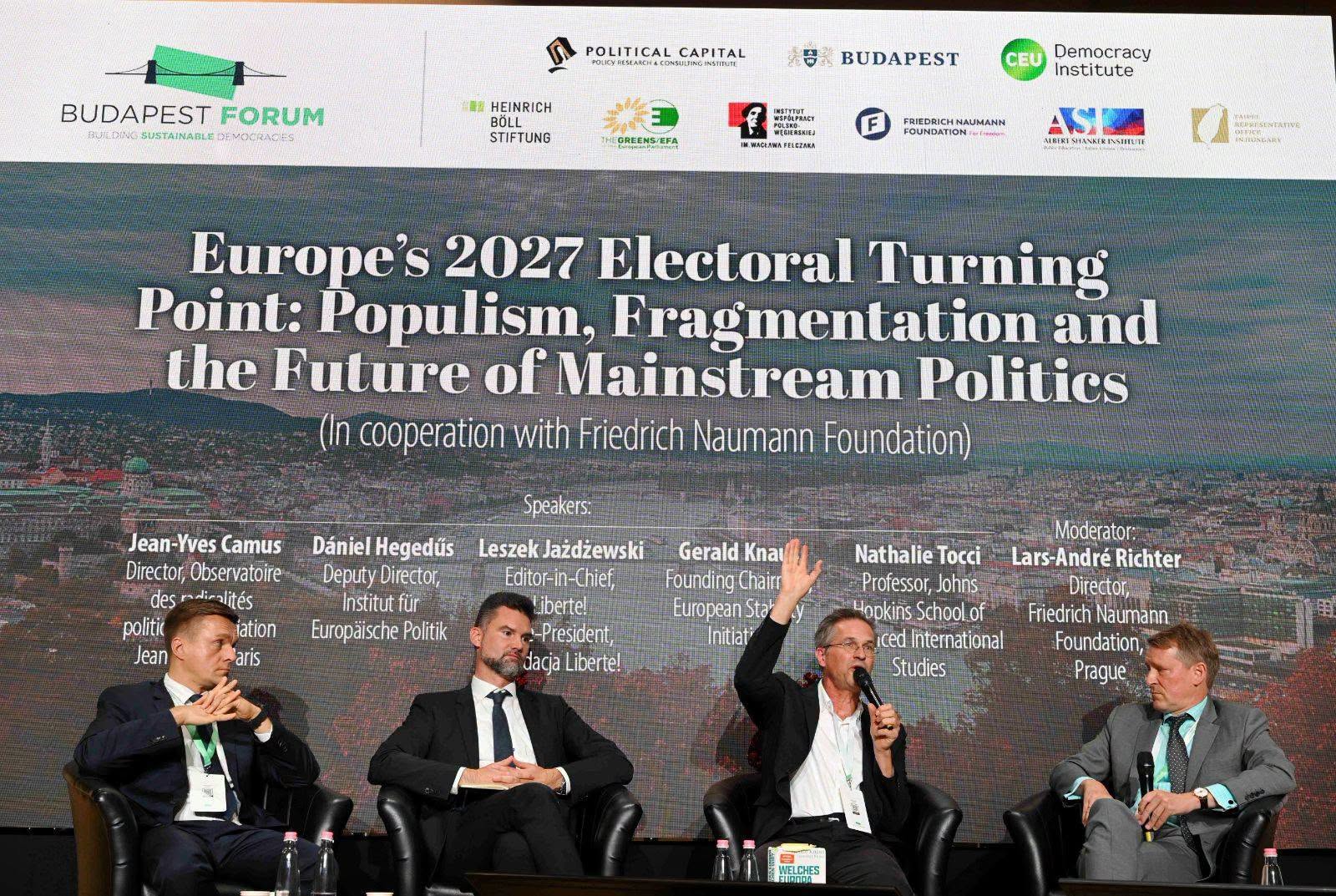
Speakers
- Dániel Hegedűs, Deputy Director, Institut für Europäische Politik
- Leszek Jażdżewski, Editor-in-Chief, Liberte!; Vice-President, Fundacja Liberte!
- Gerald Knaus, Founding Chairman, European Stability Initiative
- Nathalie Tocci, Professor, Johns Hopkins School of Advanced International Studies (video message)
- Moderator: Lars-André Richter, Director, Friedrich Naumann Foundation, Prague
Main takeaways
- Attempts by the center-right to woo the far right may pull the center-right further to the right instead of bringing it back to the center. Italy reflects a dynamic in which "the right cannibalizes itself," with a new far-right actor emerging that is even further to the right. The rise of Roberto Vannacci’s far-right party has exacerbated societal polarization and raised doubts about the ability of center-right parties to draw the far right back toward the center rather than shifting toward more radical positions themselves. If Meloni forms a coalition with the new far-right party after the next Italian election, Italy will shift further to the right.
- Populism should not be viewed as a temporary disruption, after which politics will simply return to normal. The political environment has fundamentally changed, creating new expectations for political participation and communication. Mainstream politics and institutions are struggling to keep up with these changes and the evolving nature of society. Rather than attempting to reinstate the pre-populist status quo, therefore, mainstream parties need to adapt to these new rules of engagement and policymaking while upholding their democratic principles.
- Democratic erosion in Europe’s largest member states would have consequences that extend far beyond their national borders. If democratic consensus weakens in countries such as France or Germany, the EU could lose much of its ability to enforce common democratic and rule-of-law standards. Political change in these countries could therefore provide a broader “license to autocratize” for governments elsewhere in the Union.
- The political crisis in Germany will have a profound impact on the future of the EU. As a central pillar of European integration, a significant political shift in Germany would affect the entire union. The weakening of established parties and the rise of the far-right Alternative for Germany (AfD) party pose a challenge to Europe as a whole, not just Germany. Supported by the Kremlin and the Trump administration, the AfD criticizes European integration, support for Ukraine, and existing institutions. Germany will be a key battlefield between strong leaders and defenders of the rules-based order.
- Europe does not have a democracy crisis, but rather a crisis of output legitimacy and delivery. Liberal governments must demonstrate that illiberal governance is ineffective, as evidenced by the Orbán government in Hungary. They must also show they can effectively address major challenges such as defense, technological competitiveness, social stability, and climate change.
- Mainstream parties need stronger ideas, a compelling agenda, and persuasive narratives, not only technocratic solutions. While mainstream parties often offer only incremental reforms, the far right has invested in political ideas, intellectual networks, and emotionally powerful narratives. Rather than merely reacting to the far right, mainstream actors must articulate a convincing vision for the future that emphasizes threats to European democratic peace and actively compete in the battle of ideas.
- Mainstream parties should challenge the myths propagated by populists. Populists exploit social anxiety about the decline of Europe amid geopolitical turmoil and migration by offering simple solutions and the illusion of control. However, by imitating these simplistic positions, mainstream parties undermine their credibility without necessarily winning back radical right-wing voters.
- In an increasingly confrontational geopolitical environment, European integration becomes more important, not less. Scapegoating the EU is a shortsighted communication strategy since all member states have a national interest in European integration in order to stand up against Russia. The next push for further integration could come from Central and Eastern Europe.
This panel discussion was co-organized with the Friedrich Naumann Foundation.
Explore all the panel discussions from Budapest Forum 2026 here.

Copyright 2026. Political Capital Policy Research and Consulting Institute, all rights reserved.