
Budapest Forum 2026 – After Illiberalism: Rebuilding Democratic Institutions and Reintegrating Hungary into Europe
2026-10-08
The sixth edition of the Budapest Forum, the joint event organized by the CEU Democracy Institute, the Municipality of Budapest, and Political Capital Institute focused this year on the dynamics of democratic renewal after illiberalism, the changing global security environment, and Europe’s challenging political future.
Panel discussion: After Illiberalism: Rebuilding Democratic Institutions and Reintegrating Hungary into Europe
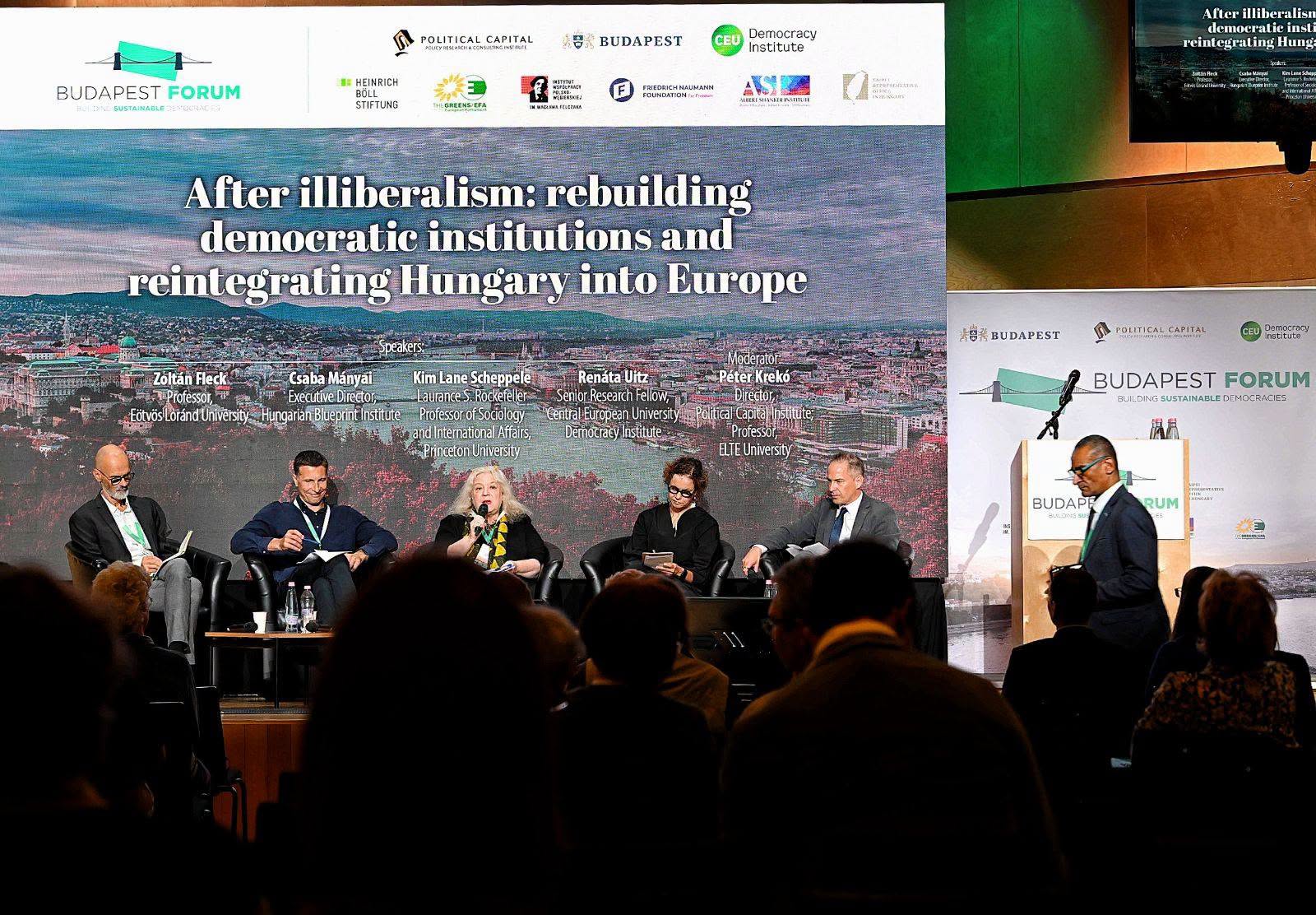
Speakers
- Zoltán Fleck, Professor, Eötvös Loránd University
- Csaba Mányai, Executive Director, Hungarian Blueprint Institute,
- Kim Lane Scheppele, Laurance S. Rockefeller Professor of Sociology and International Affairs, Princeton University
- Renáta Uitz, Senior Research Fellow, Central European University Democracy Institute
- Moderator: Péter Krekó, Director, Political Capital Institute; Professor, ELTE University
Main takeaways
- The new government faces a delicate balance between legal continuity and necessary disruption. Panelists highlighted that rebuilding democracy after an autocratic period requires knowing which autocratic laws to maintain to uphold stability and which to break or rapidly amend to prevent previous power structures from acting as veto players.
- Early legislative actions signal an effort toward rule-of-law restoration. The new administration immediately ended the long-standing permanent state of emergency through a comprehensive 60-page law while enacting targeted constitutional amendments to limit prime ministerial terms and remove institutional roadblocks.
- Rebuilding democracy requires going beyond restoring the status quo ante. Returning to the pre-2010 institutional framework is insufficient because those structures proved vulnerable to autocratic capture; instead, true democratic sustainability requires systemic innovation and a refreshed constitutional vocabulary.
- Democratic transition models carry significant risk without a fully established legal safety net. The current transitional phase operates on a "high wire" where long-term stability depends heavily on voter accountability and public engagement until a permanent constitutional framework is established.
- A bottom-up surge in public engagement distinguishes the current transition. Unlike top-down historical transitions, the recent political shift in Hungary is driven by high levels of civil society mobilization, active digital participation, and widespread public interest in governance.
- True public participation must be structured around agency rather than simple mobilization. Effective civic engagement requires moving beyond campaign-style mobilization toward participatory mechanisms where citizens can help identify core priorities and contribute their perspectives to policy decisions without stripping elected officials of decision-making power.
- Social integration and cultural shift are essential prerequisites for lasting rule of law. Pure legalism and institutional redesign cannot cure deep-seated societal disintegration; long-term democratic resilience relies on fostering a democratic culture, rebuilding local and institutional autonomy, and restoring faith in public systems.
- Constitution-building must be a multi-step, inclusive, and co-creative process. Rather than relying on superficial feedback loops or technical fixes to cardinal laws, a successful constitution-making process requires open public deliberation, building a shared democratic vocabulary, and drawing on civil society, academic, and international expertise.
- International precedents illustrate the risks of incomplete democratic recovery. Comparative experience demonstrates that failing to dismantle autocratic roots, leaving veto players in place, or over-relying on criminal prosecutions—which can turn former leaders into martyrs—can enable authoritarian forces to regain power.
- Effective delivery must accompany institutional renewal. To prevent democratic disillusionment, democratic governments must deliver tangible everyday improvements (such as healthcare and infrastructure upgrades) concurrently with structural and constitutional reforms.
Explore all the panel discussions from Budapest Forum 2026 here.

Copyright 2026. Political Capital Policy Research and Consulting Institute, all rights reserved.