
Budapest Forum 2026 – Is There a Common Central European Response to Today's Crises?
2026-10-08
The sixth edition of the Budapest Forum, the joint event organized by the CEU Democracy Institute, the Municipality of Budapest, and Political Capital Institute focused this year on the dynamics of democratic renewal after illiberalism, the changing global security environment, and Europe’s challenging political future.
Keynote speech + panel discussion: Is There a Common Central European Response to Today's Crises?
Keynote: Jakub Stefaniak, Secretary of State, Chancellery of the Prime Minister of Poland
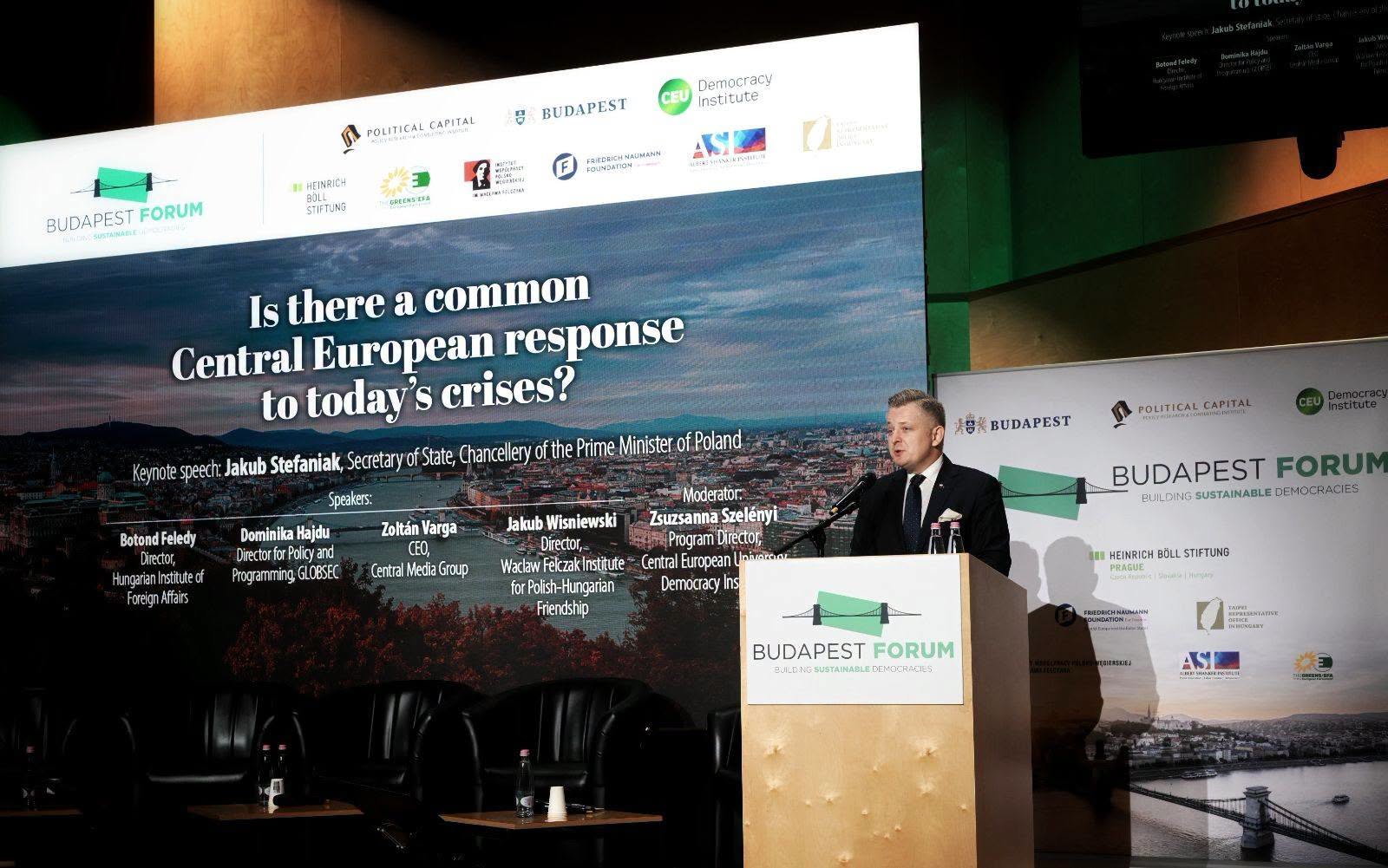
Main takeaways from Jakub Stefaniak’s keynote speech
- In response to crises, solidarity between Polish and Hungarian people have been historically present and significant. Historically, Central Europe was defined mostly as a space between empires. This, however, changed in 1989 when Central Europeans started defining themselves.
- There are 3 important points in recent history, that should be noted with regards to the region: first, 1989 – the region gains back its political freedom, then, 1999 – Poland, Hungary and Czechia joins NATO (the most important alliance for the region right now), lastly, 2004 – many countries join the European Union. These milestones were part of a historical project about sovereignty, security and European belonging.
- Thirty-five years after 1989, it is time to add another important lesson: democratic freedom requires the ability to live with disagreement.
- Hungarians are in the process of restoring democracy. This gives a chance to countries like Poland, and other Central European states to redefine possible pathways to cooperation. This should be built beyond history, in a forward-looking manner: possibly focusing on security, infrastructure, cultural and youth policy.
- The present security challenge that the region faces started in 2022, with Russia escalating the conflict in Ukraine. There needs to be a special focus on the currently undervalued “societal resistance,” but also on other areas like military mobility and harmonizing procedures within armies.
- Regarding infrastructure, there is a growing demand to travel and engage with different cultures. Therefore, conditions need to be established that allow citizens to affordably commute.
- Further cooperation should be strengthened also with respect to human capital. While research agreements and university partnerships work well, they might need to be revisited and updated according to the changes that have happened in the past 30 years.
- The region might also benefit from moving away from being the “group of resistance.” Instead, it could become an actor that sets new issues on the agenda and offers new visions for European cooperation, as exemplified by the SAFE instrument originating in Poland.
- In conclusion, Central Europe can teach Europe at least three key lessons: freedom cannot be outsourced, the region is stronger when it is together, and democracy means disagreement without fragmentation.
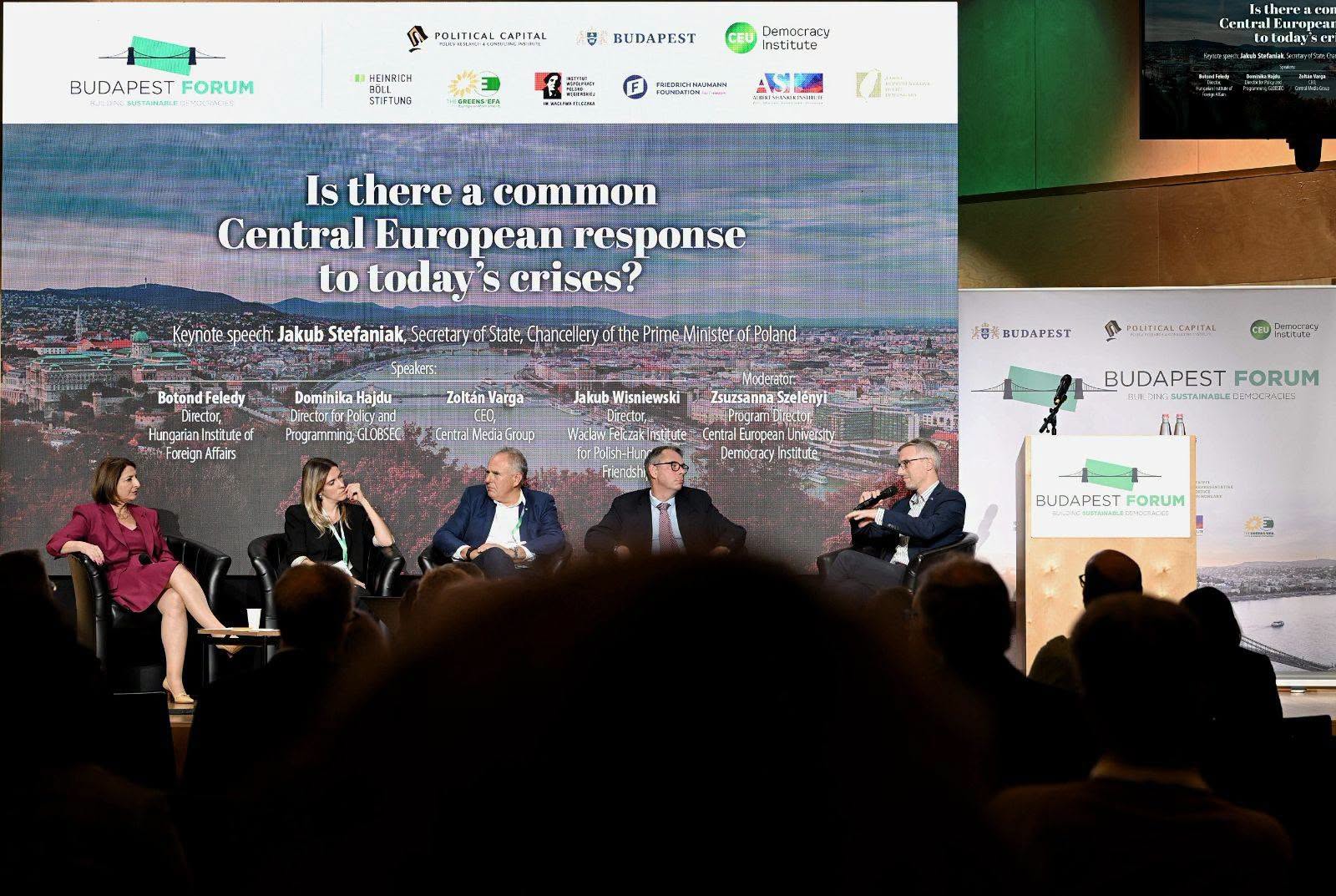
Speakers
- Botond Feledy, Director, Hungarian Institute of Foreign Affairs
- Dominika Hajdu, Director for Policy and Programming, GLOBSEC
- Zoltán Varga, CEO, Central Media Group
- Jakub Wisniewski, Director, Waclaw Felczak Institute for Polish-Hungarian Friendship
- Moderator: Zsuzsanna Szelényi, Program Director, Central European University Democracy Institute
Main takeaways from the panel discussion
- The discussion starts from the idea that Central Europe was a geographical region that – throughout history – was brought together by destiny in the shadow of big powers. This was broken in 1989 when the countries of the region became an active contributor to domestic and European politics. It is, therefore, no more about catching up and joining but about belonging. Yet, the discourse is still often questioning what the region could actually bring to Europe as a whole.
- Central Europe may not become a “saviour of Europe,” and even further, sober thinking should lead to seeing Europe becoming the periphery of the civilised world. It is especially true considering the summit between Xi Jinping and Donald Trump. Hence, things do not seem to go well for Europe which could be a wake-up call for the whole region.
- With this in mind, there are several things that could be considered as meaningful contributions to the European commons. This could be first, the benefits of catch-up growth, as evidenced by Poland. Second, a comparatively greater geopolitical awareness, being the neighbours with Russia. Third, a less decadent model of economy: Central Europe is slightly better in measures like debt to GDP, maintaining better social security systems and more sustainable immigration figures. Lastly, post-populist experiences and having the prospect of becoming a geopolitically less relevant area, which could be beneficial for focusing on competitiveness.
- Europe is, indeed, becoming the periphery of geopolitical decision-making. However, the war in Ukraine carries the potential for Central Europe that more power will be attributed to the region on a European level, moving forward. This could be seen with the case of Poland that became an increasingly important actor in decision-making processes.
- Truly, the region was a laboratory for Russian influence even before the annexation of Crimea (information manipulation, political corruption, energy as a means of influence) and is constantly being tested through, for example, drone incursions that Poland has recently experienced. These threats offer lessons to the whole of Europe, as exemplified by efforts to compile a hybrid threats playbook.
- It could be further noted that people working within businesses outside the political realm seem to be much more pragmatic. In the V4 region, Poland being the leader economically, it makes sense that the closest market for meaningful representation is the region itself, naturally converging towards an economic bloc. This is because there are similar attitudes towards private ownership, entrepreneurship and consumption in all four countries.
- Furthermore, this convergence is also evidenced by how multinational corporations operate: setting up a regional headquarter and managing V4 to Baltic countries as one market from there. Lastly, now the region is moving away from becoming the host of production facilities for Western Europe towards becoming a hotspot for Research and Development.
- Hence, the region seems to be considered as unified under economic logic, that makes Central Europe a global actor. It should be examined whether this logic infiltrates political collaboration between governments.
- Central Europe is a certain prophet for wider Europe for pragmatic politics. It is enough to look at the controversial immigration policies of the region, or the regional climate policy, or the basic attitude towards upkeeping infrastructure which now are infiltrating European policy-making.
- Even further, Central Europe’s constant insecurity helped develop a more nimble foreign policy when facing unpredictable allies like the United States. This enables the region to be more flexible in its foreign policy compared to old-fashioned Western European diplomatic channels.
- As the United States of Europe is unlikely to happen, the focus should be on pragmatic, unfashionable reforms in facing a growing China, a revisionist Russia and an unpredictable United States.
- From the perspective of Slovakia, which carries a Russia-friendly foreign policy, it should be noted that alienating the country's closest neighbours is not viable as it would jeopardise cooperation without which the country would not be able to function.
- For all Central European countries, defense procurement could be a less politically contentious sphere of cooperation. Especially, when European defense instruments (like SAFE) are pushing for joint procurement. Supply chains that are tied together could ensure cooperation that moves beyond political cycles, creating mutual dependencies within the region.
- Pragmatic moves like these, however, does not ensure that there is a societal commitment to defense. Especially, when threat perception and the quality of available information vary between countries. It remains a key question how a discourse of security could be moved beyond governments and investors towards the broader society.
- There is a big pool of financial resources to be spent on defense and infrastructure from the European Union with many suppliers queuing up. In the case of the Ukrainian recovery, the cooperation of the V4 countries could ensure entering business relations in Ukraine.
- It should also not be expected that wider Central Europe will all the sudden become fully rational, devoid of all emotions. There will never be a fully common response to current crises. There are positive incentives for cooperation for sure. However, there might be some negative ones: like an attack by Russia on a NATO ally of the eastern flank which might turn societies into a powerful force for the better.
- Yet, specifically, for the case of Slovakia, research suggests that the level of compassion towards citizens of neighbouring countries under attack (like Ukraine) is relatively low. It seems from these studies that apathy took over, and an attack on states other than Slovakia would not change public attitudes.
- Instead, in societies like this, a different perspective should be emphasized, and citizens should be empowered to know what to do in any type of crisis (e.g. climate crisis) so that if there is an attack on the country, citizens would be prepared.
- What can bring Central European states together, as mentioned by István Bibó after WWII, is living in a region between major powers under constant insecurity and political hysteria. Which might explain, among others, the importance of well-defined borders and nationalism rising and falling in the region. It would be useful to explore ideas on how to manage this sense of uncertainty and the cyclical rise of autocracy.
- Insecurity could be seen as a positive force too, being a perennial state of mind for Central and Eastern Europeans which leads to taking action for preparedness. As Central Europe levitated towards being a center of gravity geopolitically, Western Europe started utilising the voice of this region, for example, in questions on migration, climate change, and nationalism.
- Post-populism in V4 could inoculate the region for future risks, like worse authoritarian regimes than the past. The lessons learned from the experiments trying to re-establish the rule of law in Hungary, will be taken in by other more western countries as well.
- The solution against fear might also be simple economic growth in terms of GDP per capita. With higher endowments in the household, citizens can start caring about other things than fear. This, especially, needs to be combined with a strong understanding on the identity that the region should face future crises with.
- It might be also beneficial for the region to humbly look around to other cooperating regions in Europe, like the Baltic, Nordic or Benelux countries, and understand how and what they are doing. For example, seeing the impact of the Nordic defense cooperation on drone-platform development might raise European defense companies much faster. Many low hanging fruits are available in this regard and the countries just need to connect efforts in aiming for them. Additionally, the region should be allowed to be inspired by other already successful regional cooperations.
Explore all the panel discussions from Budapest Forum 2026 here.

Copyright 2026. Political Capital Policy Research and Consulting Institute, all rights reserved.