
Budapest Forum 2026 – Lessons from the Past: What Does the Revolution of 1956 Teach Us about the Crises we are Facing Today?
2026-10-08
The sixth edition of the Budapest Forum, the joint event organized by the CEU Democracy Institute, the Municipality of Budapest, and Political Capital Institute focused this year on the dynamics of democratic renewal after illiberalism, the changing global security environment, and Europe’s challenging political future.
A lecture by Krisztián Ungváry (Research Professor, University of Miskolc), in Hungarian:
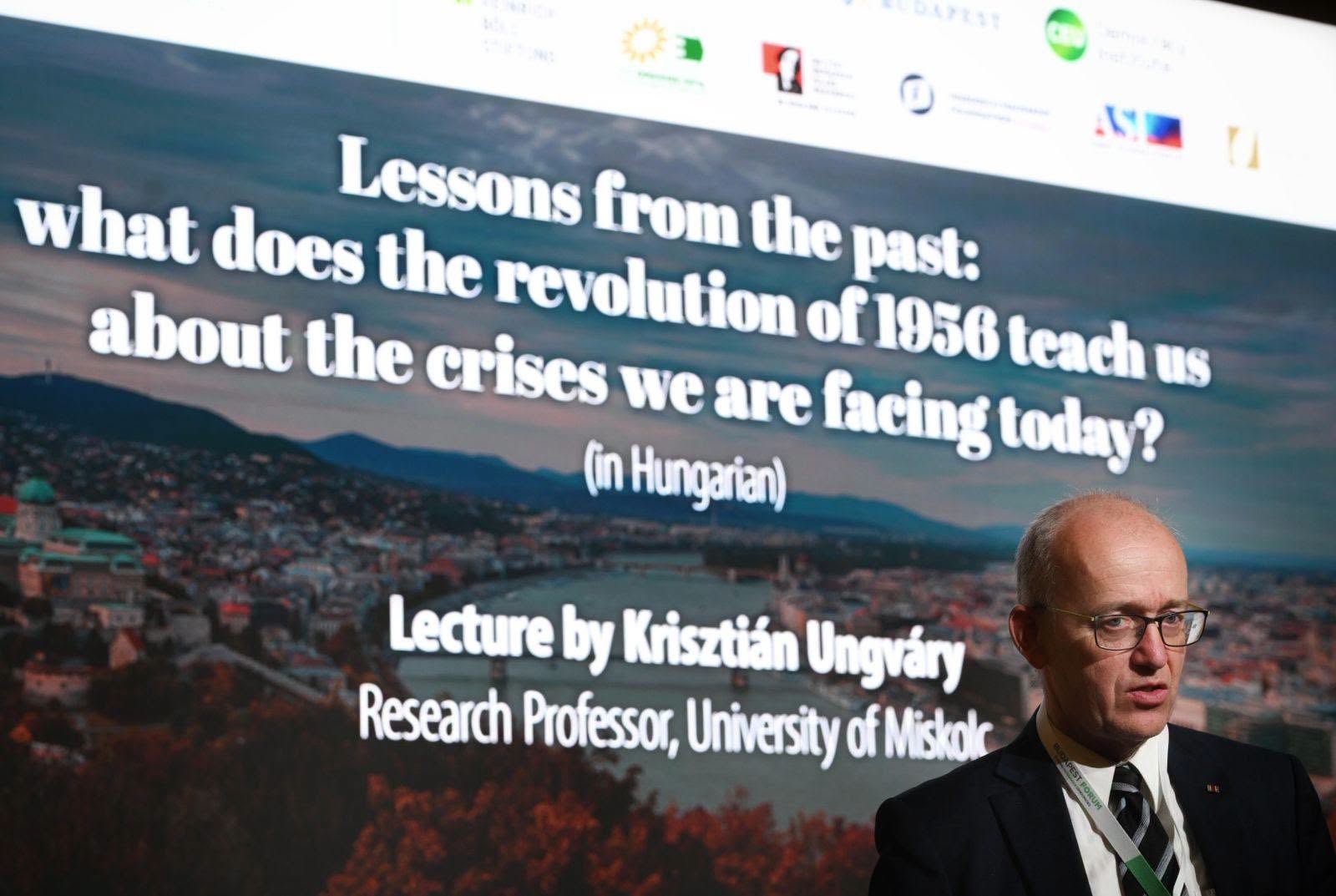
Main takeaways from the lecture “Lessons from the Past: What Does the Revolution of 1956 Teach Us about the Crises we are Facing Today?”
- The revolution of 1956 in Hungary was not only about a revolution but about the fall of a dictator.
- It was also not an isolated event arising from thin air, but there were events preceding it both domestically and internationally. Domestically, the reinterment of László Rajk (Hungarian politician, former communist interior minister) or the emerging debate circles of Hungarian intellectuals – originally aiming to showcase freedom of expression under communist rule – should be noted. Additionally, during one of these debates, György Litván (Hungarian historian and activist) demanded Mátyás Rákosi to resign.
- Internationally, key events preceding the revolution were the 20th Congress of the Communist Party of the Soviet Union and the uprising in Poznań.
- Equally importantly, there were major events happening across the country before the revolution started in Budapest: for example, a student assembly in Miskolc on 22 October, similarly in Szeged and Debrecen.
- While in other socialist countries in Eastern Europe nationalism and Stalinism went hand in hand, in Hungary communist leaders did not only take away Hungarians’ sense of freedom but their sense of national belonging as well.
- It is key to remember that all levels of society participated in the revolution. This understanding will help understand the future reception of the revolution.
- The interpretation of the events of 1956 has fluctuated dramatically over time. Right after the events the ruling party called participants “counter-revolutionary rabble,” while later it was noted as a “glorious uprising” and even later a “series of tragic events.”
- In the period immediately after, it was yet again labeled as a counter-revolutionary conspiracy, but that softened back to tragic events, and around 1989 it was seen again as an uprising or a civil war.
- During the Orbán regime, the image of the young freedom fighters (Pesti Srácok) was revitalized. The interpretation became especially contentious with Balázs Orbán’s (former Political Director to Prime Minister Viktor Orbán) infamous comparison between the events of 1956 and the war in Ukraine.
- Additionally, the narrative should also be debunked which assumed that Western nations were urging the revolution under the promise of their assistance arriving later: historical records (documents, radio recordings from BBC, Voice of America, Radio Free Europe) are clear that this has never happened.
- Since the heroes of the revolution, the Arrow Cross members, gendarmes and the military officials of the Horty-era army were buried in a mass grave, “it is our responsibility to separate their memories.”
Explore all the panel discussions from Budapest Forum 2026 here.

Copyright 2026. Political Capital Policy Research and Consulting Institute, all rights reserved.