
Budapest Forum 2026 – Narratives of the Past, Struggles of the Present: Democracy and Social Cohesion in Hungary
2026-10-08
The sixth edition of the Budapest Forum, the joint event organized by the CEU Democracy Institute, the Municipality of Budapest, and Political Capital Institute focused this year on the dynamics of democratic renewal after illiberalism, the changing global security environment, and Europe’s challenging political future.
Panel discussion (in Hungarian): Narratives of the Past, Struggles of the Present: Democracy and Social Cohesion in Hungary
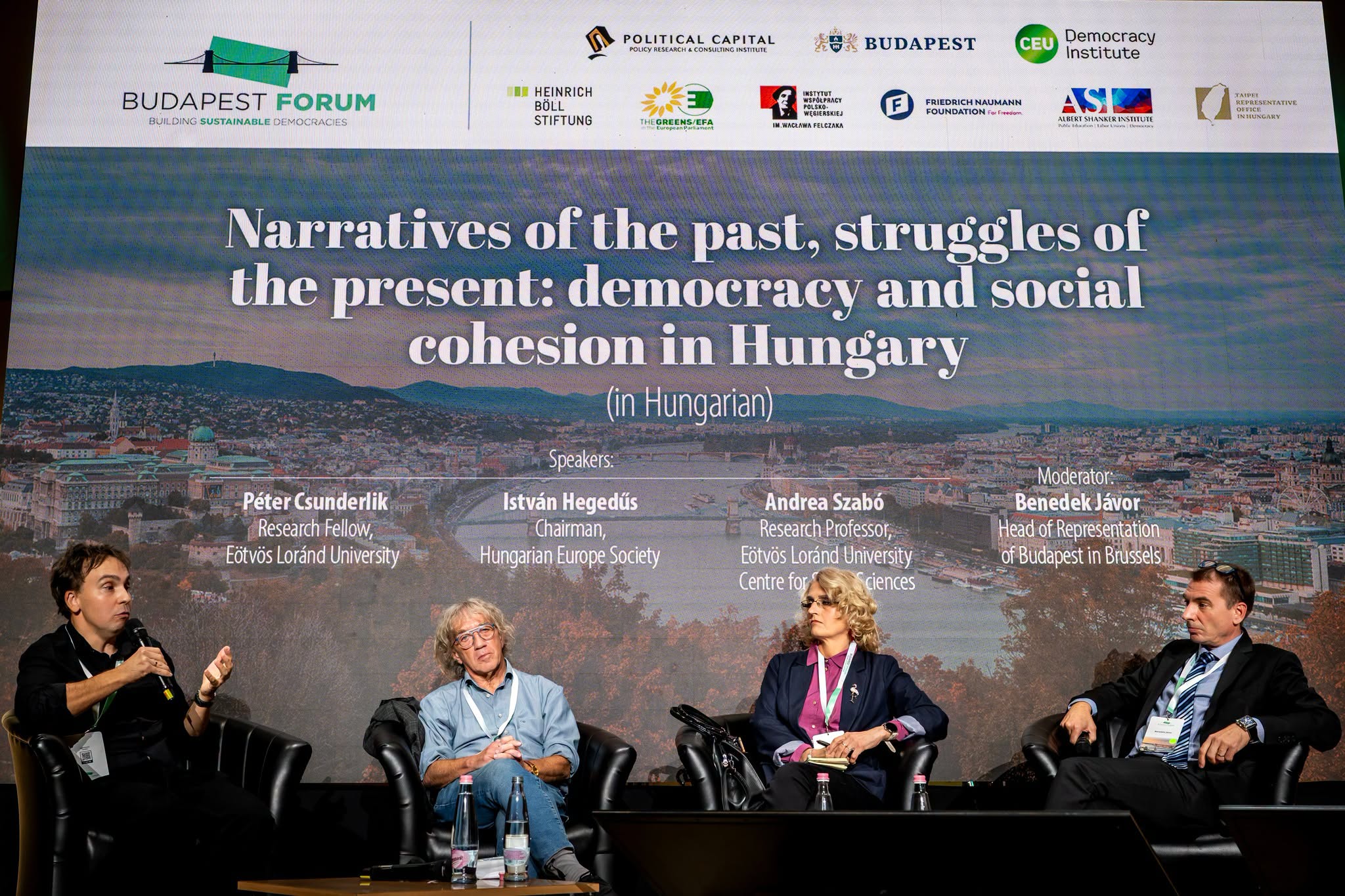
Speakers
- Péter Csunderlik, Research Fellow, Eötvös Loránd University
- István Hegedűs, Chairman, Hungarian Europe Society
- Andrea Szabó, Research Professor, Eötvös Loránd University Centre for Social Sciences
- Moderator: Benedek Jávor, Head of Representation of Budapest in Brussels
Main takeaways
- Only on a few occasions in history has Hungary been regarded as a positive example in international politics, most notably during the 1956 revolution, the democratic transition of 1989–1990, and now, following the fall of the Orbán regime in 2026.
- Widespread disillusionment with democracy and capitalism following the 1989–1990 transition, compounded by the 2008 economic crisis, helped Fidesz secure an overwhelming parliamentary majority and establish a fundamentally new constitutional system.
- Parallels can be drawn between Hungary’s pre-World War I political system and the Orbán era, particularly in the subordination of state institutions to party interests and the resulting capture of the state. Common features include a manipulated electoral system, politically motivated redistribution, and an opposition that effectively becomes part of the system. Orbán also invoked former Prime Minister István Tisza (1903–1905 and 1913–1917) as a historical reference, portraying modernity as a threat from which only strong leadership could protect the nation. At the inauguration of Tisza’s statue near Parliament, Orbán described the monument as symbolizing a “new era of nation-building.”
- Péter Magyar succeeded in reclaiming national symbols that Orbán had long sought to monopolize politically, including the national flag and the tricolor cockade. Orbán’s political identity had been closely tied to his self-portrayal as a freedom fighter, reinforced by narratives suggesting that Fidesz embodied the nation itself and that the nation could not be in opposition.
- Attitudes towards Orbán and Hungary’s democratic backsliding evolved only gradually within the EU, particularly in the European People’s Party (EPP). In the early 2010s, the EPP prioritized internal cohesion and sought to keep Fidesz within its ranks, while many struggled to recognize Orbán’s transformation from a liberal freedom fighter in the late communist era into an illiberal leader. This containment strategy gradually lost credibility, ultimately leading to Fidesz’s suspension from the EPP and its subsequent departure from the EPP group in the European Parliament.
- The foundations of the Orbán government began to weaken well before its eventual defeat, despite Fidesz’s victory in the 2022 elections. In autumn 2021, polls suggested that the united opposition could secure a majority. However, Fidesz regained momentum through generous redistribution measures and subsequently capitalized on Russia’s invasion of Ukraine. Soaring inflation and stagnating economic growth gradually undermined the government’s support, while the February 2024 presidential clemency scandal marked a decisive turning point.
- TISZA emerged in the political vacuum created by growing public dissatisfaction, promising not merely a change of government but the dismantling of the entire system of corruption and patronage. However, the new TISZA government faces significant risks if it fails to establish effective accountability mechanisms and deliver meaningful institutional change.
- Hungary’s experience does not necessarily provide a blueprint for the collapse of other illiberal governments in Europe, given the considerable differences between national contexts and the limited generalizability of individual cases. In Hungary, the emergence of a high-profile defector from within the governing elite, combined with accumulated public anger, proved crucial to the collapse of the illiberal system.
Explore all the panel discussions from Budapest Forum 2026 here.

Copyright 2026. Political Capital Policy Research and Consulting Institute, all rights reserved.